One scored audit of everything you ship.
Code, sites, apps, APIs, containers, infrastructure, cloud and mobile builds, audited for security, accessibility, performance and seven more areas. From your terminal, your CI or your AI agent.
bunx openaudit .openaudit audits itself on every push: 85/100
Ten areas, each with its own grade
Every finding belongs to one area, and each area scores 0 to 100 from the severity of what was found. Pick an area to see what openaudit checks, where, and with which tools. The letters are openaudit's grades for its own repository.
Security
D53/100 in openaudit's own audit
Leaked secrets (also in git history), injection, XSS and other risky code, weak crypto, disabled TLS or JWT checks, security headers, TLS, DNS and email spoofing protection, exposed files and APIs, container, IaC and cloud misconfiguration, risky mobile manifests, and optional dynamic scanning
Applies to
- Codebase
- URL
- Web app
- Container
- Infrastructure as code
- Mobile build
- Cloud account
src/config.ts:14code.secrets/aws-access-key-idWrapped tools, used when installed
- actionlint
- bandit
- brakeman
- bun
- cargo
- cargo-audit
- checkov
- docker
- dockle
- gitleaks
- golangci-lint
- gosec
- govulncheck
- grype
- hadolint
- kics
- kube-linter
- kubescape
- mobsfscan
- npm
- osv-scanner
- pip-audit
- pnpm
- prowler
- ruff
- semgrep
- shellcheck
- testssl.sh
- trivy
- trufflehog
- zizmor
Agent playbooks
- agent.authz
- agent.injection
- agent.secrets-config
- agent.webapp-security
- agent.mobile
- agent.iac-architecture
Accessibility
A100/100 in openaudit's own audit
WCAG checks in JSX, Vue, Svelte, HTML and CSS; axe-core and pa11y on rendered pages; Android layouts; keyboard and screen-reader journeys walked by an agent
Applies to
- Codebase
- URL
- Web app
- Mobile build
src/components/Hero.tsx:22code.accessibility/img-alt-missingWrapped tools, used when installed
- lighthouse
- pa11y
Agent playbooks
- agent.a11y-journeys
- agent.ux-content
Performance
A100/100 in openaudit's own audit
Page weight, caching, compression, Core Web Vitals, Lighthouse, image and bundle size, container image size, mobile app size and native libraries
Applies to
- Codebase
- URL
- Web app
- Container
- Mobile build
https://example.com/ head > scriptweb.performance/render-blocking-scriptWrapped tools, used when installed
- cargo
- lighthouse
Agent playbooks
- agent.performance
SEO
Not graded in openaudit's own audit: its auditors run on url, web app targets
Titles and descriptions, crawlability, canonical URLs, sitemaps, structured data, broken links
Applies to
- URL
- Web app
Built in
https://example.com/pricingweb.seo/broken-linkWrapped tools, used when installed
- lighthouse
Agent playbooks
- agent.ux-content
Privacy
A100/100 in openaudit's own audit
Trackers and cookies set before consent, analytics, ad and session-replay SDKs, personal data written to logs, mobile permissions
Applies to
- Codebase
- URL
- Web app
- Mobile build
https://example.com/webapp.browser/tracking-cookie-before-consentWrapped tools, used when installed
- mobsfscan
Agent playbooks
- agent.privacy
- agent.mobile
Best practices
A100/100 in openaudit's own audit
Repository hygiene (README, licence, security policy, CI, lockfiles), Dockerfile and IaC lint, GitHub Actions hardening
Applies to
- Codebase
- URL
- Web app
- Container
- Infrastructure as code
- Mobile build
Dockerfile:7container.dockerfile/add-instead-of-copyWrapped tools, used when installed
- actionlint
- checkov
- dockle
- hadolint
- kics
- kube-linter
- lighthouse
- semgrep
- spectral
Agent playbooks
- agent.secrets-config
- agent.ux-content
Reliability
F18/100 in openaudit's own audit
Type errors, broken pages and redirect chains, missing Kubernetes probes and limits
Applies to
- Codebase
- URL
- Web app
- Container
- Infrastructure as code
k8s/deployment.yaml:18iac.kubernetes/probes-missingWrapped tools, used when installed
- actionlint
- biome
- cargo
- eslint
- golangci-lint
- kics
- kube-linter
- kubescape
- mypy
- oxlint
- ruff
- shellcheck
- spectral
- staticcheck
- tsc
Agent playbooks
- agent.performance
- agent.iac-architecture
Maintainability
A98/100 in openaudit's own audit
Linting, strict typing settings, duplication, dead code, deep nesting and oversized files
Applies to
- Codebase
tsconfig.json:4code.quality/ts-strict-disabledWrapped tools, used when installed
- biome
- cargo
- eslint
- golangci-lint
- jscpd
- knip
- mypy
- oxlint
- ruff
- staticcheck
- tsc
Supply chain
A100/100 in openaudit's own audit
Known-vulnerable dependencies, unpinned versions and actions, OpenSSF Scorecard, licences, SBOMs, container image CVEs
Applies to
- Codebase
- Container
- Infrastructure as code
- Mobile build
Dockerfile:1container.dockerfile/from-latestWrapped tools, used when installed
- brakeman
- bun
- cargo-audit
- govulncheck
- grype
- npm
- osv-scanner
- pip-audit
- pnpm
- scorecard
- syft
- trivy
- zizmor
Agent playbooks
- agent.iac-architecture
Compliance
A100/100 in openaudit's own audit
Licence obligations, cookie consent, OWASP Top 10 and CWE Top 25 mapping, CIS cloud benchmarks
Applies to
- Codebase
- URL
- Cloud account
Built in
vendor/parser.c:1code.scancode/strong-copyleftWrapped tools, used when installed
- prowler
- scancode
- syft
Agent playbooks
- agent.privacy
Point it at anything you ship
openaudit detects what the target is and what it contains, then runs the auditors that apply. Seven kinds of target and every major language, scored in the same ten areas.
By target
| Target | SecuritySec | AccessibilityA11y | PerformancePerf | SEOSEO | PrivacyPriv | Best practicesBP | ReliabilityRel | MaintainabilityMnt | Supply chainSup | ComplianceComp |
|---|---|---|---|---|---|---|---|---|---|---|
Codebasebunx openaudit . | 30 auditors | 1 auditors | 3 auditors | none | 3 auditors | 6 auditors | 13 auditors | 14 auditors | 13 auditors | 4 auditors |
URLbunx openaudit https://example.com | 9 auditors | 5 auditors | 2 auditors | 3 auditors | 3 auditors | 4 auditors | 1 auditors | none | none | 2 auditors |
Web appbunx openaudit https://example.com --browser | 5 auditors | 4 auditors | 1 auditors | 1 auditors | 1 auditors | 1 auditors | 1 auditors | none | none | none |
Containerbunx openaudit image:nginx:1.27 | 7 auditors | none | 1 auditors | none | none | 4 auditors | 2 auditors | none | 4 auditors | none |
Infrastructure as codebunx openaudit ./infra | 11 auditors | none | none | none | none | 6 auditors | 6 auditors | none | 4 auditors | none |
Mobile buildbunx openaudit ./app-release.apk | 5 auditors | 1 auditors | 1 auditors | none | 3 auditors | 1 auditors | none | none | 1 auditors | none |
Cloud accountbunx openaudit cloud:aws --only cloud | 1 auditors | none | none | none | none | none | none | none | none | 1 auditors |
Dot size is the number of auditors that cover the area for that target, counted from the registry when the site is built.
By language
| Language | Security | Dependencies | Types, lint and quality |
|---|---|---|---|
| JavaScript / TypeScript | built-in rules, Semgrep | npm, pnpm, Yarn and Bun lockfiles via OSV.dev; npm / pnpm / bun audit | tsc, oxlint, Biome, ESLint*, knip*, strict tsconfig checks |
| Python | built-in rules, Semgrep, Bandit | requirements*.txt, poetry.lock; pip-audit | ruff, mypy*, type-checker configuration |
| Go | built-in rules, Semgrep, gosec | go.mod; govulncheck* | staticcheck, golangci-lint* |
| Rust | Semgrep | Cargo.lock; cargo-audit | clippy*, [lints] and unsafe policy checks |
| Ruby | built-in rules, Semgrep, Brakeman (Rails) | Gemfile.lock | None |
| PHP | built-in rules, Semgrep | composer.lock | None |
| Java / Kotlin | built-in rules, Semgrep, mobsfscan (Android) | Maven and Gradle via osv-scanner and Trivy | None |
| C# / .NET | built-in rules, Semgrep | NuGet via osv-scanner and Trivy | None |
| Swift / Objective-C | mobsfscan (iOS) | None | None |
| Shell | None | None | ShellCheck, set -euo pipefail checks |
| HTML, CSS, JSX, Vue, Svelte | accessibility and performance rules | None | None |
* Opt-in: run it with --only <id>, e.g. --only code.clippy. The next section explains why some tools are opt-in.
One issue, one finding
Most audits are a pile of tool outputs that disagree. openaudit runs the tools, merges what they agree on, and hands you one scored result.
Run
Point it at a folder, a URL, an image or a cloud account. It picks the auditors that apply and runs them in parallel. A scanner that isn't installed is skipped with an install hint.
Merge and score
When several tools report the same issue, you get one finding that names who confirmed it, scored once. Each area scores 0 to 100 from what remains.
Example: one leaked key, three tools, one finding. A single critical finding takes an area to 50.
Report and gate
One report as HTML, JSON, SARIF, Markdown or CSV.
--fail-onsets the exit code for CI, and--diffkeeps a pull request to the files it changed.
A report people actually read
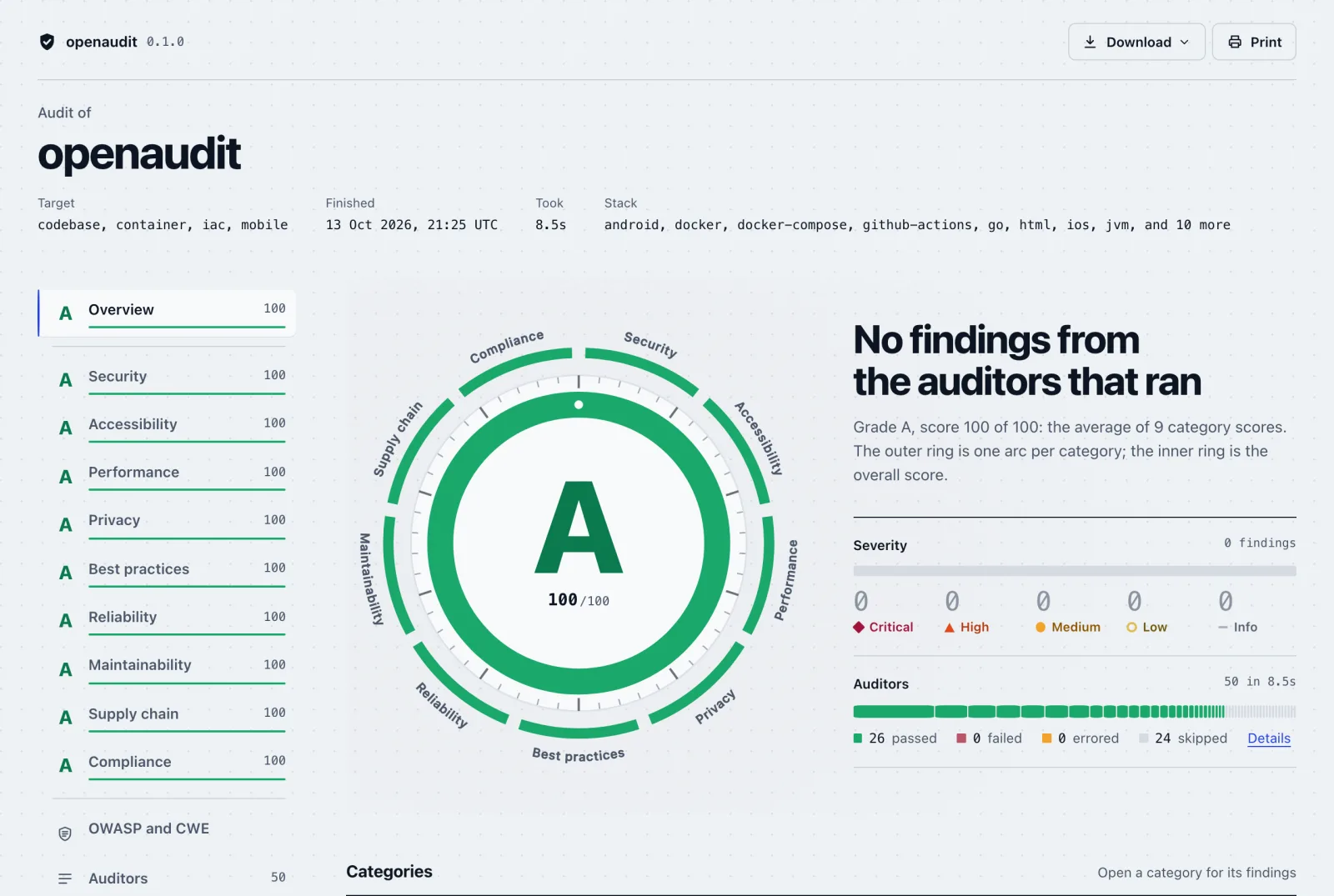
One self-contained HTML file with no external requests. It opens offline, works with JavaScript off and prints cleanly, so it can be attached to a CI run or an email.
 Open the live report
Overview
An overall grade with one arc per area, severity counts and the status of every auditor that ran or was skipped.
A tab per area
Each area has its own tab, with filters, search and findings grouped by rule.
OWASP and CWE
Findings mapped to the OWASP Top 10 and the CWE Top 25.
Downloads
The same audit as JSON, SARIF, Markdown or CSV, straight from the page.
Built for agents
Some audits need judgment rather than patterns. openaudit lets the agent you already use drive the whole loop, and checks its fixes.
MCP server, over stdio or HTTP
Claude Code, Cursor, Codex and other agents get
run_audit,get_finding,compare_reportsand the playbook tools. Remote agents connect over Streamable HTTP with a bearer token.10 playbooks for judgment calls
Authorisation, injection paths, privacy data flows, keyboard journeys and more. Your agent does the review with its own tools; its findings merge into the same scored report. No extra API key.
A JSON agent mode
--jsonprints one JSON report on stdout and nothing else, andopenaudit schemagives its JSON Schema.A skill for the whole loop
skills/openaudit/SKILL.mdteaches an agent the loop: baseline, triage, run the playbooks, fix, then verify withcompare_reports.
claude mcp add openaudit -- bunx openaudit mcp- Audit this repo and fix what matters.
- openaudit run_audit target: "."
- 78/100, grade C. 1 critical and 3 high findings from 41 auditors.
- openaudit get_playbook id: "agent.authz"
- Authentication and authorization review: inventory every route, then check who can reach it.
- Read src/routes/admin.ts
- openaudit submit_findings 2 findings
- Merged into the report. Security 61 to 54.
- Edit src/routes/admin.ts, src/config.ts
- openaudit compare_reports
- 3 fixed, 0 new.
Runs where you already work
From a terminal, an editor, a pull request or a container. Every route produces the same report.
CLI
bunx openauditopenaudit needs Bun 1.4 or newer. Scanners are optional: an auditor whose tool is missing is skipped with an install hint, and the rest of the audit runs normally. To run from source, see Contributing.
bunx openaudit .                            # a codebase
bunx openaudit https://example.com          # a live site (add --browser for Playwright + axe-core)
bunx openaudit ./app-release.apk            # a mobile build (.apk, .aab, .ipa)
bunx openaudit image:nginx:1.27             # a container image
bunx openaudit cloud:aws --only cloud       # a live cloud account (Prowler)

bunx openaudit . -f html -o report          # write the interactive report to report/
bunx openaudit doctor # which optional scanners are installedMCP
openaudit mcpThe MCP server lets an agent run audits, read findings with the surrounding source code, compare reports to confirm fixes, and work through playbooks. Playbooks are judgment-heavy checks, such as authorization, business logic and real-world accessibility, that the agent does with its own code and browser tools. It then reports the results back with submit_findings. Playbooks need no API key.
claude mcp add openaudit -- bunx openaudit mcpGitHub Action
wezter96/openauditThe repository is also a GitHub Action. On pull requests it reports only findings in changed files, uploads SARIF to code scanning, attaches the reports as an artifact and writes a job summary.
permissions:
  contents: read
  security-events: write

steps:
  - uses: actions/checkout@v7
    with:
      fetch-depth: 0 # diff mode compares against the base branch
  - uses: wezter96/openaudit@main # pin to a commit SHA in real use
    with:
fail-on: highDocker
ghcr.io/wezter96/openauditghcr.io/wezter96/openaudit bundles openaudit with the free scanners, pinned to exact versions. Images are multi-arch (linux/amd64, linux/arm64) and ship with provenance and an SBOM.
# Audit the current directory. Run as yourself: git refuses repositories owned by
# another user, and reports are written as you
docker run --rm --user "$(id -u):$(id -g)" -v "$PWD:/src" -w /src \
  ghcr.io/wezter96/openaudit . -f html,sarif -o openaudit-report --fail-on high

# Audit a live site with a real browser
docker run --rm ghcr.io/wezter96/openaudit:latest-full https://example.com --browser

# See which tools are installed
docker run --rm ghcr.io/wezter96/openaudit doctorGitLab CI
include: remoteOn merge requests the job audits only changed files (--diff origin/$CI_MERGE_REQUEST_TARGET_BRANCH_NAME); on the default branch and schedules it audits everything.
include:
  - remote: https://raw.githubusercontent.com/wezter96/openaudit/main/integrations/gitlab/openaudit.gitlab-ci.yml

variables:
OPENAUDIT_FAIL_ON: high # optionalpre-commit
id: openauditThe hooks audit the whole working tree with --offline --fail-on high, so staged changes are covered and a commit stays quick. They do not use --diff: it compares commits (<ref>...HEAD) and staged changes are not committed yet, so --diff HEAD would find nothing. To check a branch's committed changes instead, run the hook on pre-push with your own arguments.
repos:
  - repo: https://github.com/wezter96/openaudit
    rev: main # pin to a tag or commit
    hooks:
      - id: openaudit          # needs Bun on PATH
# - id: openaudit-docker # or: the Docker image, nothing else to installSARIF
-f sarifRun the audit from the repository root, so that SARIF file paths line up with the files in the repository. The job needs the security-events: write permission to upload SARIF.
- uses: oven-sh/setup-bun@v2
- name: openaudit
  run: bunx openaudit . --format sarif,markdown --out openaudit --fail-on high
- name: Upload SARIF
  if: always()
  uses: github/codeql-action/upload-sarif@v4
  with:
    sarif_file: openaudit/openaudit-report.sarif
    category: openaudit
- name: Job summary
  if: always()
run: cat openaudit/openaudit-report.md >> "$GITHUB_STEP_SUMMARY"IDEs
mcp.jsonCursor and VS Code start the same MCP server from a project's mcp.json (VS Code uses "servers" instead of "mcpServers"), so the agent in your editor can run audits and playbooks.
{
  "mcpServers": {
    "openaudit": { "command": "bunx", "args": ["openaudit", "mcp"] }
  }
}Safe on hostile input
openaudit treats every target as hostile. Tools that would run project code are opt-in, and nothing builds or installs what it scans.
Files
Reads are confined to the project root and never follow symlinks out of it.
HTTP
User-supplied headers go only to the exact target origin, and credentials are stripped on cross-origin redirects.
Agents
openaudit's own agents have no shell, and the browser is held to the target origin at the network layer. deepsec's reviewer does get a sandboxed shell, which is why it is opt-in.
Wrapped tools
Tools never build or install the target. They run from temporary directories so project config can't redirect them (pnpm hook files, pa11y config, oxlint JS plugins, Spectral custom functions). Linters whose config is code (ESLint, clippy, mypy, golangci-lint) are opt-in.
Git
Every git call overrides
core.fsmonitorand hooks, diffs compare commits rather than the working tree, and history scans run on a fresh mirror clone.
Free and open source
No account, no licence key and no hosted service in the way.
MIT licensed
Read the code, run it anywhere, change it. The licence
Free tools only
Every scanner openaudit wraps is free and open source, and keeps its own licence.
Tokens are the only cost
And only if you choose the AI features: AI triage and the headless agentic auditors are opt-in.
openaudit is shared with OpenSverige, Sweden's open community for people building AI agents and MCP servers. Come show what you've audited, or tell us what openaudit missed.
Questions
Does it upload my code?
No. Audits run on your machine and file reads stay inside the project. Some auditors use the network: dependency checks look packages up on OSV.dev, and URL audits send low-volume GET and HEAD requests to the site you point them at. --offline turns off everything except the target. Code only leaves your machine if you turn on the opt-in agentic auditors, which send the files the agent reads to Anthropic; --ai sends finding metadata, never file contents.
Which tools do I need installed?
Only Bun 1.4 or newer. The 32 built-in auditors need nothing else. Each of the 45 wrapped scanners is used when it is on your PATH, and a missing one is skipped with an install hint. openaudit doctor lists what is available, and the Docker image ships with the free scanners preinstalled.
Does it replace Snyk or SonarQube?
It covers much of the same ground, such as static analysis, vulnerable dependencies and code quality, using free and open-source scanners. It also puts websites, containers, infrastructure, cloud accounts and mobile builds in the same report. It runs where you run it rather than as a hosted service, and it can run alongside a commercial tool: both can upload SARIF to GitHub code scanning.
How is the score calculated?
Each finding adds a penalty: 40 for critical, 15 for high, 5 for medium, 1 for low and nothing for info. An area scores 100 × 40 ÷ (40 + penalty), so one critical finding gives 50 and one high gives 73. Grades start at 90 for A, 80 for B, 70 for C, 50 for D. The overall score is the average of the areas that were examined. More on scoring
Can AI agents use it?
Yes, it is built for them. Add the MCP server and your agent can run audits, read findings with the surrounding source, work through the playbooks and confirm its fixes with compare_reports. --json gives scripts and agents one machine-readable report. Agent setup
Is it free?
Yes. openaudit is MIT licensed and every scanner it wraps is free and open source. The only cost is tokens, and only if you choose to use the AI features.
Audit your own project
bunx openaudit . -f html -o reportWrites the interactive report to report/. Open report/openaudit-report.html in any browser.